Curious why homes in New Canaan feel so distinct from one street to the next? That variety is part of what makes this market so compelling. If you are buying, selling, or simply trying to understand the town better, it helps to know how architecture shapes daily living, long-term upkeep, and resale appeal. Let’s dive in.
New Canaan Has More Than One Look
New Canaan is often associated with famous modern houses, but its architectural identity is much broader. Sources from CTvisit and the New Canaan Museum & Historical Society point to a layered housing history that includes Colonial-era homes, farmhouses, mid-century modern residences, and estate-scale properties.
That mix matters because it gives the town a streetscape that feels collected over time rather than built in a single wave. For you as a buyer or seller, that means architectural style is not just visual. It can influence how a home lives, how it is maintained, and how it is positioned in the market.
Colonial Homes Still Shape The Town
New Canaan’s roots date back to 1715, and that early history still shows up in the local housing stock. The New Canaan Museum highlights examples like the Hanford-Silliman House, built between 1761 and 1764, and the 1765 Alma Colbron House, described as a traditional colonial saltbox with a center chimney.
These details help explain why older New Canaan homes often feel intimate and grounded in early New England forms. You may see symmetrical facades, simple massing, and interior layouts that reflect an earlier way of living. Even when updated over time, these homes often retain the scale and character that make historic properties so appealing.
What Colonial Layouts Can Mean For You
In practical terms, older colonial-era houses often feel more compartmentalized than later homes. Center-chimney layouts and saltbox forms can create cozy rooms and a strong sense of enclosure.
That charm can come with tradeoffs. Based on the age and construction details documented in local examples, these homes may call for close attention to masonry, insulation, and mechanical systems over time. Every house is different, but age and original construction deserve careful review.
Mid-Century Modern Put New Canaan On The Map
New Canaan is nationally recognized for its modern architecture. According to the New Canaan Museum, more than 100 modern houses were built between 1949 and 1973, and its Modern Homes Survey identified 91 modern houses in the community.
This period gave the town a design identity that still draws attention today. The museum notes that the movement was fueled by architects who studied at Harvard under Walter Gropius, which helps place New Canaan within a larger design story while keeping the town’s role highly local and specific.
The Glass House Shows The Extreme
If you want to understand New Canaan modernism at its boldest, the Glass House is the clearest example. The National Trust describes Philip Johnson’s design as having glass walls, no interior walls, and a 49-acre site with 14 structures.
That kind of architecture is about more than appearance. It reflects a lifestyle built around openness, transparency, and a strong relationship to the land. In modern homes across New Canaan, buyers are often responding to that same idea, even when the design is less radical than the Glass House itself.
What Modern Homes Can Mean For Daily Life
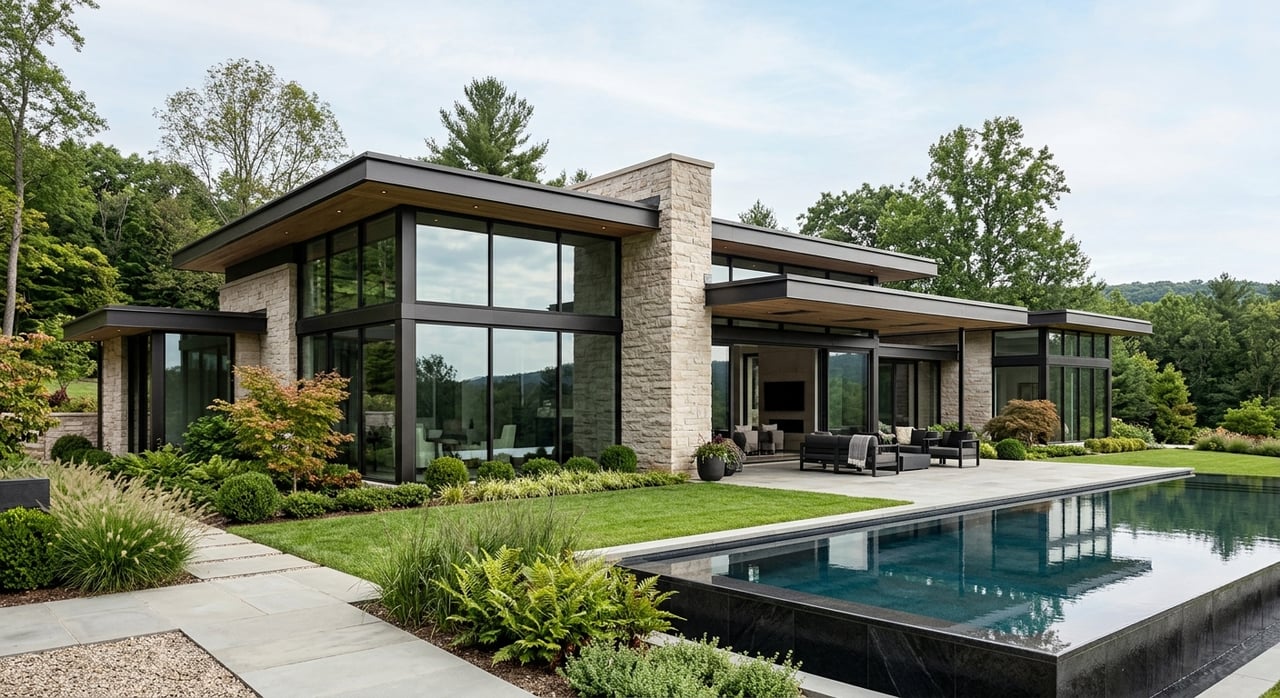
Modernist houses usually create a very different living experience from older colonials. Open interiors, broad glazing, and stronger indoor-outdoor connections can make a home feel light-filled and highly connected to its setting.
At the same time, those design features may require more attention to glazing, climate control, privacy, and maintenance of original details. Those are practical considerations inferred from the design itself. For many buyers, the appeal lies in preserving the architectural language while making the home work comfortably day to day.
Estate Properties Add A Landscape Story
Another important part of New Canaan architecture is the estate-scale property. In these homes, the land is not just background. It is often central to the property’s identity and value.
Waveny helps illustrate that point. The property began as a 285-acre estate assembled in 1895, later shaped by architect William B. Tubby and the Olmsted Brothers Landscape Architects, and donated to the town in 1967. It is now a public park, but its history offers a useful lens on how estate living has shaped New Canaan.
Why Grounds Matter As Much As The House
Historic estate planning often centered on terraces, formal gardens, expansive views, and supporting structures. That design approach shows how large-acreage ownership in New Canaan can involve far more than the main residence.
For homeowners, that often means ongoing stewardship of lawns, trees, drainage, driveways, and screening. On estate properties, architecture and landscape usually need to feel coherent together. Buyers tend to notice when the house, grounds, and outbuildings support one another clearly.
Architecture Affects Renovation Decisions
In New Canaan, ownership questions often come back to how much value is tied to original design. That is especially true when a home sits in a historic district or carries strong architectural significance.
Connecticut law allows local historic districts to require a certificate of appropriateness before certain exterior alterations, new construction, or demolition. Reviews can consider features such as windows, doors, light fixtures, utility structures, building materials, scale, and the relationship to nearby buildings.
New Canaan’s Historic District Matters
New Canaan’s historic district was created in 1963, and the town’s regulations make clear that the commission reviews exterior architectural features. That includes appearance, materials, components, finishes, measurements, construction methods, scale, and spatial relationships.
Interior features are generally outside that jurisdiction. For you, that means the exterior of a historic property may require more planning before visible changes are made. That can help preserve neighborhood character, but it can also add time and process to renovations.
Preservation Can Support Resale
Preservation is not only about restrictions. It can also be part of a property’s market strength. Connecticut’s State Historic Preservation Plan notes that local historic designation can support community identity and help enhance and protect property values while limiting incompatible exterior changes.
In resale terms, that can be attractive to buyers who value consistency and architectural integrity. A well-preserved home often benefits from the confidence that surrounding character is less likely to shift dramatically. For some sellers, that protection becomes part of the home’s story.
Documentation Adds Real Value
For architecturally significant homes, records matter. The New Canaan Museum & Historical Society maintains extensive local archives, including more than 3,500 volumes as well as manuscripts, deeds, newspapers, photographs, Colonial-era documents, and town tax and real estate records.
That depth of documentation can be especially useful when you are buying or selling a notable home. Provenance, renovation history, and evidence of original materials can strengthen both marketing and buyer confidence. In a town where architecture carries real weight, a clear paper trail can add meaningful context.
Why Architecture Matters In The Market
New Canaan sits within Fairfield County’s Gold Coast context, which CTvisit describes as a city-meets-country region. That framing helps explain why architecture here is often tied to more than style alone. Design, landscape, and setting all contribute to how a property is perceived.
For buyers, the question is often not just which home is most attractive. It is which kind of living experience fits best. A historic colonial, a mid-century modern residence, and an estate property may all be beautiful, but they ask different things of an owner.
Choosing The Right Home Style
When you evaluate New Canaan homes, it helps to think beyond finishes and square footage. Consider how the architecture aligns with your day-to-day priorities, your comfort with upkeep, and your long-term plans.
A useful framework is to ask:
- Do you prefer defined rooms or open living spaces?
- How important are original architectural details to you?
- Are you comfortable with the upkeep that may come with older construction?
- If the property includes significant land, do you want the responsibility that comes with landscape stewardship?
- If resale matters, will future buyers likely value preservation and authenticity in this home?
These are not minor questions in New Canaan. They often sit at the center of what makes one property feel right and another feel less practical, even at a similar price point.
A Smarter Way To Read The Market
In a town like New Canaan, architecture is part of the investment story. The strongest properties often balance authenticity and usability, whether they are landmark moderns, early homes, or estate compounds.
That is why careful positioning matters for sellers and informed evaluation matters for buyers. Understanding how a home fits into New Canaan’s architectural history can help you see value more clearly, ask better questions, and make more confident decisions.
If you are considering a move in lower Fairfield County and want a discreet, informed perspective on architecturally significant homes, The Sarsen Team offers confidential guidance tailored to the property and the moment.
FAQs
What architectural styles are most associated with New Canaan homes?
- New Canaan is known for a mix of Colonial-era homes, farmhouses, mid-century modern residences, and estate-scale properties, with national recognition for its significant concentration of modern houses.
What makes New Canaan mid-century modern homes so important?
- The town saw more than 100 modern houses built between 1949 and 1973, and the movement became a defining part of New Canaan’s identity through architects influenced by Harvard and Walter Gropius.
What should buyers know about owning a historic home in New Canaan?
- Buyers should understand that historic properties may involve more attention to original materials, older construction systems, and in some cases exterior review requirements if the home is within a local historic district.
What should homeowners know about New Canaan historic district rules?
- New Canaan’s historic district regulations focus on exterior architectural features, including materials, finishes, scale, construction methods, and spatial relationships, while interior features are generally outside the commission’s jurisdiction.
Why do estate properties in New Canaan require different planning?
- Estate properties often involve stewardship of the land as well as the house, including concerns such as lawns, trees, drainage, driveways, views, and supporting structures.
Why is documentation important when selling an architecturally significant New Canaan home?
- Documentation can help verify provenance, renovation history, and original materials, which may strengthen buyer confidence and support the home’s overall market story.